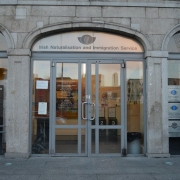
TRANSFER OF ALL NATIONWIDE RENEWALS TO THE ISD ONLINE PORTAL

On October 14th, the Department of Justice announced that responsibility for all renewals of Irish immigration residence permissions will be transferred from the Garda National Immigration Bureau (GNIB) to the Registration Office of Immigration Service Delivery (ISD). This applies to persons residing in all counties, and it will come into effect on the 4th of November this year. However, the GNIB will still be undertaking responsibility for first registrations for applicants who reside outside of Cork, Dublin, Kildare, Meath, Limerick and Wicklow.

From 4th of November onwards, there will be no need for persons to present at the Burgh Quay Registration Office to make a residence permission renewal, except in limited circumstances where it is deemed necessary. All such renewals should be submitted through the ISD online renewals portal.

Applications for renewal made through this portal will be accepted up to 12 weeks prior to the expiry of the previous permission, to allow ample time for processing. This is also the case for applications to change stamp category. To view the progress of an online application, the applicant can visit the Immigration Services Website, where they will find live updates for online renewal applications in the processing stage.

Before permission can be renewed online, applicants must set up an ISD account here. Applicants will be required to upload digital copies of certain documents according to which immigration permission they looking to renew; a list of the required documents can be found here. If the applicant does not fall within the category of applicants who are exempt from the €300 registration fee, they must have their credit or debit card details ready in order to pay this. The list of applicants who are exempt from making this payment is as follows:

  • Applicants with refugee status;
  • Applicants with subsidiary protection status;
  • Applicants with leave to remain under Section 49 of the International Protection Act 2015;
  • Applicants aged between 16 and 18 years of age;
  • Applicants who are resident based on marriage to an Irish citizen;
  • Applicants who are the family member of an EU citizen;
  • Applicants who are Ukrainian citizens and certain foreign nationals resident in the State as a Beneficiary of Temporary Protection;

Once the online application has been processed, the applicant’s new IRP card will be posted directly to the address provided in the application.

Please see link for further information regarding the renewal process:

https://www.irishimmigration.ie/transfer-of-all-nationwide-renewals-to-the-isd-online-portal/

UPCOMING CITIZENSHIP CEREMONY

The Department of Justice has announced that the next citizenship ceremony will take place on Monday the 16th September 2024. The ceremony is being hosted in the Dublin Convention Centre, at North Wall Quay in Dublin 1.

The Department of Justice has recently published details regarding the citizenship ceremonies on the Immigration Service Delivery website.

The ISD webpage confirms that invitations to upcoming citizenship ceremonies will issue to eligible candidates via post and email. Invitees may bring one adult guest only to the ceremony. Children are not permitted to attend the ceremonies. Minor applicants whose applications for naturalisation are approved are not required to attend a citizenship ceremony and will receive their Certificate of Naturalisation by post.

When candidates arrive at the ceremony, they will first be required to check-in at the registration desk. Candidates are required to bring either their passport or driver’s licence as a form of photo ID with them to the ceremony. Candidates will then be given an information booklet and an Irish emblem. The ceremony will last approximately two hours and will be presided over by a judge.

At the ceremony, candidates take an oath of fidelity to the nation that states that they will respect the rights, freedoms and laws of Ireland. Candidates will be provided the words of the declaration on the day of the ceremony. Following the citizenship ceremony, a Certificate of Naturalisation will be posted to each eligible candidate by registered post.

The ISD webpage also provides a list of the previous citizenship ceremonies that have been held, dating back to 21st April 2017, and links to the live streams of a selection of previous citizenship ceremonies, dating back to 9th December 2019.

The ISD webpage regarding Citizenship Ceremonies can be found here.

Berkeley Solicitors wishes to congratulate our clients who have recently been approved their applications for a Certificate of Naturalisation, and all who will be attending these ceremonies.

RECENT COURT OF APPEAL JUDGEMENT – A QUESTION REFERED TO THE COURT OF JUSTICE OF THE EUROPEAN UNION

The Court of Appeal has decided to refer a question to the CJEU in the case of R.S v Minister for Justice [2024] IECA 151, delivered on 21st June 2024.

The question relates to whether the Minister can make a decision/finding pursuant to the 2015 Regulations in relation to marriage of convenience/ fraud after the individual has become an Irish citizen through naturalisation.

The facts of this case surrounded an applicant who obtained an EU Fam residence card based on his marriage to an EU national in 2010 and he later naturalised as an Irish citizen. The applicant later separated and divorced from his EU National spouse.

In 2019, a third-party non-EEA national made an application for a residence permission on the basis that she was the mother an Irish citizen child, to whom the applicant was the father.

This resulted in the Residence Division contacting the EUTR Investigation unit who in turn opened an investigation into the applicant’s marriage to his ex-wife in 2010.

In December 2019 the Minister sent a letter to the applicant proposing to “revoke” his residence card, even in circumstances where at that time he was an Irish citizen.

In February 2020 the Minister revoked the residence card previously held by the applicant on the basis that he had submitted misleading documents and also on the basis that his marriage was one of convenience.

The Applicant reviewed this decision and in September 2020 the decision was upheld on review.  A further review was sought by the applicant, and this was refused.

Correspondence between the applicant’s solicitor and the Respondent ultimately led to the above decisions being withdrawn and replaced with a new decision of February 2022. As the Court noted:

The wording of new decision of 1st February 2022 was different and, significantly, did not purport to “revoke” anything

In the decision of February 2022, the Minister held that the applicant had submitted false and misleading documents and that his marriage was one of convenience. The decision stated in material part:

This marriage was never genuine, and any entitlement or status conferred under the Directive from your marriage to the Union citizen concerned are deemed withdrawn from the outset.”

The High Court found the decision of the Minister to be lawful in that it did not proport to revoke or cancel anything, the fact that the applicant had acquired Irish citizenship did not make him immune to Ministerial enquiries into a grant of permission to him in the past.

The Court of Appeal held there are two key questions in this case:

  • Does the Directive apply to an Irish citizen after he has ceased to be a beneficiary of it by reason of acquiring citizenship?
  • Does the Minister have a “free-standing” power under the Regulations to make certain factual determinations at a time and in a context where there is no possibility of linking the determination to any decision to “revoke, refuse to make or refuse to grant” any right, entitlement or status in accordance with the Regulations?

The Court went on to consider the relevant Case law including Lounes v Secretary of State for the Home Department – In which it was held that once the applicant obtained British citizenship, as she was living in the UK, she was no longer a beneficiary of the Directive as she was no longer outside her member state.

The Court also compared the arguments in the present case to the judgment of Chenchooliah v Minister for Justice and Equality (Case C-488/21), 10th September 2019, where the Directive was still held to apply to the applicant even though it was clear she was no longer a beneficiary of same.

The Minister contends that the Regulations should be read as entitling the Minister to make a determination about a past state of affairs and also having regard to the context to the Regulations, implementing a Directive in which the prevention and detection of fraud and abuse of EU residence rights is an important component

The Court ultimately determined that a question should be referred to the CJEU:

Whether Directive 2004/38/EC applies to a person who previously obtained the benefit of derived residence in a Member State by virtue of being a spouse of an EU national exercising Treaty rights but who has more recently become a citizen in the host State and is no longer the beneficiary of any benefit under the Directive, solely for the purpose of investigating and (if appropriate) making a determination or reaching a conclusion that he engaged in a fraud or abuse of rights and/or a marriage of convenience in the past in order to obtain a benefit under the Directive?

The full judgements in this case can be accessed below.

https://www.courts.ie/acc/alfresco/7bbff9a4-5a97-40a6-a3bb-fe710e9048d4/2024_IECA_151.pdf/pdf#view=fitH

EMPLOYMENT PERMITS ACT 2024 SIGNED INTO LAW

The Department of Enterprise have now announced that the Employment Permits Act 2024 will come into effect from Monday, 2nd September 2024.

The new Act consolidates and updates employment permit law, which had previously been scattered across various Acts. The Act repeals the Employment Permits Act 2003 and the Employment Permits Act 2006, as well as the Employment Permit Regulations 2017. An information note on the key changes is available at https://enterprise.gov.ie/en/publications/publication-files/employment-permits-act-2024-information-note-on-key-changes.pdf.

CHANGES TO THE LABOUR MARKET NEEDS TEST (LMNT)

The criteria requiring employers to place adverts for vacancies in print media (newspapers) has been removed. The requirement to publish an advertisement with the Department of Social Protection Employment Services/EURES employment network for a minimum of 28 days (continuously) continues.

The new LMNT criteria require the applicant to publish the vacancy notice both with the Department of Social Protection JobsIreland/EURES online employment services, and on a second online platform for 28 days also. These online platforms can be any electronic system for the online publication of information that are easily accessible by Irish/EEA citizens including websites, software or any other electronic technology that provides for the online publication of information. Online platforms can include newspaper websites or dedicated employment websites. Any website, software, or electronic technology that provides online publication of information, with the principal purpose being to publish offers of employment, is eligible.

Both notices placed with the Department of Social Protection Employment Services/EURES employment network and on the additional second online platform must contain the following information:

  • a description of the employment
  • the name of the employer
  • the minimum annual remuneration
  • the location/s of employment
  • the hours of work

Our understanding currently, subject to the publication of the new Regulations in this matter, is that applications for employment permits must be made within 90 days from the day in which the Department of Social Protection notice was first published.

SEASONAL EMPLOYMENT PERMITS

The new Seasonal Employment Permit is a short-term employment permit for a non-EEA national to work for a maximum of 7 months per calendar year in a seasonally recurrent employment. The Permit will be first introduced under a limited pilot scheme for horticultural workers later this year, with the intention that it will commence in early 2025. There will be a requirement for employers to become registered as approved seasonal employers and to obtain annual pre-approval. There will be a prescribed minimum number of employees, turnover, and balance sheet total for the previous year for prospective seasonal employers. Seasonal employers will also need to provide accommodation and appropriate health insurance for their seasonal employees.

REVOCATION OF EMPLOYMENT PERMITS

A new provision also requires that a permit holder must commence employment within a period of six months from when the permit is granted or comes into force. This new requirement may have serious consequences for holders of employment permits who are visa-required but who are experiencing significant delays in the employment visa process.

There is no explicit confirmation that the employment permit will be cancelled if not taken up within 6 months, but that seems to be the clear implication from the legislation. The view of our office is that this is quite concerning for visa-required employment permit holders who may be unable to take up their permits within 6 months due to delays.

CHANGING EMPLOYER WITHIN THE SAME TYPE OF ROLE

The new Act allows employment permit holders to change employer by application to the Minister after a period of 9 months on their permit has elapsed (but before 22 months has elapsed) without the need to apply for a new employment permit or conduct a new Labour Market Needs Test. The permit will continue to last only for its initial duration.

Please note that this only applies to General Employment Permit holders seeking to change employers for the same type of role (identified by its 4-digit SOC code), or Critical Skills Employment Permit holders seeking to change employers within the same category of role (identified by its 3-digit SOC code). For example, a meat processing operative holding a General Employment Permit can move to another meat processing role, or an engineer holding a Critical Skills Employment Permit can move to another engineering role.

The following conditions apply to the change of employer process:

  • The maximum number of applications for change of employer that may be granted to a permit holder has been set at three.
  • A new contract of employment signed by both the new employer and employee is required to be submitted.
  • The employee is required to commence employment with the new employer within one month of the new permit being issued. It is important to note that the new employment cannot be commenced until the employment permit has been reissued.
  • A change of employer request form will be available for the new employer and employee to sign and submit through a dedicated email address.

PROMOTION OR INTERNAL TRANSFER IN THE ROLE

Where an employment permit holder has been granted a promotion in the same company, the Act includes a provision to allow for this where a permit holder would use the same skills and the employment remains eligible, without having to apply for a new employment permit. The situation will be assessed on renewal.

CHANGING EMPLOYERS TO ANOTHER TYPE OF ROLE OR A NEW ROLE WITH THE SAME EMPLOYER

The Employment Permits Act 2024 allows employment permit holders to apply for a new employment permit for a new type of role, whether with their current employer or a new employer, after a period of at least nine months.

The legislation provides discretion to grant prior to the nine-month period in cases evidencing a change of circumstances or instances of exploitation.

MINIMUM ANNUAL REMUNERATION

The new Act requires the Minister to carry out a yearly review on average weekly earnings in Ireland to calculate increases in the minimum annual remuneration for employment permits. This is likely to mean increases in the minimum annual remuneration for employment permit holders on an annual basis in line with increases in the average wage in Ireland. Our advice is that employers should start planning in anticipation of the new figures being announced. Please note that these increases will also apply to renewals, where the initial permit may have been applied for on the basis of a lower salary.

If you or your employer have any queries regarding the new employment permit rules, please do not hesitate to contact us.

This blog article has been prepared on the basis of current immigration law and policy, which is subject to change. Please keep an eye on our blog and Facebook page where articles relating to updates and changes in immigration law and policy are regularly posted.


IMMIGRATION TO IRELAND HITS 17-YEAR HIGH ACCORDING TO DATA RELEASED BY THE CENTRAL STATISTICS OFFICE

The Central Statistics Office (CSO) has published data that shows that 149,200 people have immigrated to Ireland in the 12-month period between April 2023 and April 2024. Of these numbers, 30,000 were returning Irish citizens, 27,000 were EU citizens, and 5,400 were UK citizens. 86,800 immigrants were citizens of other countries.

In response, the Taoiseach Simon Harris has said that the government need to do more to prepare Ireland for population growth.

The figures released by the CSO reveal that the number of immigrants entering Ireland during this period was the highest since the period between April 2006 and April 2007.

The population of Ireland is now estimated to be 5.38 million, increasing by 98,700 since 2023.

The CSO also published data showing that more than 69,000 people emigrated in the same period. Of that figure, 34,700 were Irish citizens, 10,600 were EU citizens, and 21,500 were citizens of other countries. An estimated 10,600 people moved from Ireland to Australia; an increase of 126%, which represents the highest level of emigration to Australia since 2013. Just 6,400 people moved from Australia to Ireland. 15,200 people also left Ireland to live in the UK, while 20,500 people moved to Ireland from the UK.

Those aged between 25 and 44 accounted for 48% of all emigrants. According to the CSO, the number of emigrants from countries outside of the EU has risen by 49%, when compared to the 14,400 in 2023, however a significant number of these were Ukrainian.

According to the Irish Times, there were a positive net migration of 79,300 people in the 12-month period. There was also a natural increase of 19,400 people in the State, made up of 54,200 births and 34,800 deaths.

Speaking about the population growth in the State, Taoiseach Simon Harris stated, “there’s no doubt governments, the Government that I lead, will now need to do a better job in terms of forward planning, preparing for population growth, wondering what that means for public services, what that means for investment, what that means for staffing levels.” He also emphasised that “Inward migration is a good thing. We should be very clear about that. What Ireland needs to do is make sure it has the systems in place to properly process people, to provide people who are coming seeking international protection with a ‘yes’ or a ‘no’ more quickly.”

The full Irish Times article can be accessed here:

https://www.irishtimes.com/ireland/2024/08/27/immigration-to-ireland-hits-17-year-high-as-emigration-also-rises/#:~:text=Figures%20for%20year%20to%20April,State%20in%20three%20successive%20years&text=Some%20149%2C200%20people%20immigrated%20to,Central%20Statistics%20Office%20(CSO)

RECENT SUPREME COURT JUDGEMENT REGARDING THE BEST INTERESTS OF CHILDREN IN THE CONTEXT OF DEPORTATION DECISIONS

The Supreme Court delivered a judgement in the case of A.Z, M.Z and C.Z (a minor) v Minister for Justice and Equality [2024] IESC 35 on 25th July 2024.

The facts of this case surrounded the deportation order of a man who is the father of an Irish citizen child, and is also married to an Irish national. A challenge was brought by the family against the decision of the Minister not to revoke the father’s deportation order. Judge Phelan found in the applicants’ favour in the High Court and the matter was appealed by the Minister for Justice.

The Supreme Court upheld the decision of the High Court.

Several issues arose in the case, one being whether the Minister’s assessment of the father’s immigration application was in line with Article 42A of the Irish Constitution.

Article 42A was inserted into the Constitution in 2015.

Article 42A.1 states as follows:

  1. The State recognises and affirms the natural and imprescriptible rights of all children and shall, as far as practicable, by its laws protect and vindicate those rights.


Sections 2,3 and 4 of the Article are specific provisions as they relate to specific types of proceedings including adoption, custody and access.

Article 42A.1 is a provision of much wider application.

It can be argued that Article 42A.1 recognises and affirms the already pre-existing constitutional rights of children.

Whilst Article 42A.4 is a very specific provision requiring the Minister to legislate for specific types of proceedings, we would say that Article 42A.1 has general application.

Interestingly, in this case, the Minister’s decision in respect of the man’s immigration application contained no reference to Article 42A. In the proceedings, the Minister contended that the Minister had complied with her Constitutional obligations despite no specific reference to the Article being made in the decision.

The Court did not agree with this argument and held that Judge Phelan in the High Court was correct to find that she could not be satisfied, based on careful consideration of the decision, that the rights of the child where properly identified and assessed.

The Supreme Court affirmed the judgment of Judge Phelan which found that following the insertion of Article 42A into the Constitution “effective State protection for the rights of the child now required a greater focus on the child as an individual, separate from the family unit as a whole and not subordinate as part of the family unit. She held that the Supreme Court had found that Article 42A results in some recalibration of the protections which had already been available to children under the other provisions of the Constitution, not least Articles 40, 41 and 42…”

By virtue of Article 42A.1 the Minister is required to identify and assess the individual rights of the child, separate and distinct from the rights of a family as a whole.

It appears to us that the Supreme Court has also held that in the context of deportation decisions, resulting in indefinite separation between a parent and child, the Minister is obliged to consider the best interests of the child as a primary consideration, with each case being decided on its own individual merits. Whilst the Minister must consider the best interests of the child as a primary consideration, there are many considerations the Minister is entitled to have regard to and the requirement that the best interests of the child be a “paramount” consideration is confined to the specific provisions in Article 42A.4.

The full judgements in this case can be accessed below.

https://courts.ie/acc/alfresco/5e689789-56c6-481a-b63b-b74248a1d14b/2024_IESC_35_(Woulfe%20J).pdf/pdf#view=fitH

https://courts.ie/acc/alfresco/0fb290b4-95f9-4e60-b296-8f18398ec7ac/2024_IESC_35_(Collins%20J)_Unapproved.pdf/pdf#view=fitH

DEPARTMENT OF ENTERPRISE ANNOUNCES 150 NEW WORK PERMITS FOR SEA FISHERS

The Department of Enterprise has announced a new quota of 150 employment permits for sea fishers in a bid to address skills shortages in the Irish fishing fleet.

This decision moves the role of sea fisher from the Atypical Working Scheme to the employment permit system. The role of sea fisher in the Irish fishing fleet is now eligible for a General Employment Permit with a minimum salary requirement of €34,000, up to a quota of 150 permits. This move will ensure that non-EEA sea fishers will have access to the same benefits and protections as other non-EEA nationals employed in the State.

For further information, please see the press release published by the Department of Enterprise, Trade, and Employment:

https://enterprise.gov.ie/en/news-and-events/department-news/2024/july/03072024.html

Berkeley Solicitors are available to provide support and assistance to any persons applying for an employment permit.

This blog article has been prepared on the basis of current immigration law and policy, which is subject to change. Please keep an eye on our blog and Facebook page where articles relating to updates and changes in immigration law and policy are regularly posted

UPDATE ON PROCESSING OF VISA APPLICATIONS IN THE EMBASSY OF IRELAND, NEW DELHI, INDIA

The Embassy of Ireland, New Delhi, has announced a number of updates on the processing of visa applications and appeals in a notice dated 18th July 2024.

Firstly, the notice provides that those in the following visa categories will now have their application transferred to the Dublin visa office for processing:

  • Family member of EU/EEA/Swiss cit. (de facto partner);
  • Family member of EU/EEA/Swiss cit. (other);
  • Family member of EU/EEA/Swiss cit. (spouse);
  • Join Family (Irish nat.)(de facto partner);
  • Join Family (de facto partner CSEP/HA) ;
  • Join Family (UK nat.);
  • Minister of Religion; and
  • Volunteer

This means that, for these categories, the Dublin visa office processing times now apply.

The notice provides an update on median processing times for applications processed in the Embassy of Ireland, New Delhi. Notably, the processing time for Join family visas is now listed as 3 calendar months for a first instance decision, and 12 calendar months for an appeal decision. The notice states that the Embassy currently has a backlog of Join family appeals, specifically those involving Category B sponsors in Ireland who failed to meet the criteria set out in the Policy Document on Non-EEA Family Reunification.

The notice additionally states that applications which have not been processed within the median processing times stated on the website are likely delayed for various reasons, such as a delay in biometric information, ineligibility or that the application is awaiting verification.

With regard to Join family visas specifically, delays likely mean that the sponsor has not met the criteria set out in the Policy Document on Non-EEA Family Reunification. The notice states that, in such cases, applications will be reviewed under the exceptional criteria which can take up to a year to be fully assessed.

The full notice can be found here:

Visa Information, times and decisions | Embassy of Ireland, India | Ireland.ie | Ireland – this is Ireland

This blog article has been prepared on the basis of current immigration law and policy, which is subject to change. Please keep an eye on our blog and Facebook page where articles relating to updates and changes in immigration law and policy are regularly posted.

NEW REVOCATION PROCEDURE FOR NATURALISED IRISH CITIZENS

The Court, Civil Law, Criminal Law and Superannuation (Miscellaneous Provisions) Bill 2024 has passed through both Houses of the Oireachtas and is now awaiting being signed into law by the President. Once enacted, the Bill will insert new provisions into the Irish Nationality and Citizenship Act 1956 (as amended) that deals with the revocation of citizenship for naturalised Irish citizens. The previous system for revocation was struck down by the Supreme Court four years ago in the Supreme Court case of Damache v Minister for Justice [2020] IESC 63 for failing to meet the “high standards of natural justice” which the Court held must apply to the process of revocation of certificates of naturalisation. The Supreme Court held that any such process must comply with fair procedures and contain adequate safeguards for persons facing the revocation of their citizenship.

Section 19 of the Irish Nationality and Citizenship Act 1956 (as amended) currently allows the Minister for Justice to revoke a certificate of naturalisation in cases where (1) the certificate was procured by fraud, misrepresentation whether innocent or fraudulent, or concealment of material facts or circumstances, (2) the person has failed in their duty of fidelity to the nation and loyalty to the State, (3) the person is ordinarily resident outside Ireland for a continuous period of seven years and without reasonable excuse has not annually registered an intention to retain Irish citizenship, (4) the person is a citizen of another country which is at war with Ireland, or (5) the person has voluntarily acquired another citizenship. These reasons for revocation are unchanged by the new Bill. The Supreme Court case of Damache struck down the process the Minister had previously used to revoke naturalisation, and therefore there was and remains no pathway for the Minister to revoke naturalisation, until such time as the new Bill is signed into law by the President.


Berkeley Solicitors has reviewed the Court, Civil Law, Criminal Law and Superannuation (Miscellaneous Provisions) Bill 2024 with a view to advising clients who may be issued with notices of intention of revocation of citizenship. The new Bill raises concerns in respect of short timeframes for naturalised citizens facing the revocation process to engage (as little as six weeks in total from proposal to revocation pursuant to sections s.19(IC) and (IJ)), the requirement to only use one method to serve of the notice of intention to revoke, the level of independence afforded to the Committee of Inquiry in circumstances where the Minister will prescribe their procedures and the availability of oral hearings, and the exception to the requirement to give reasons to a naturalised citizen facing the revocation process when issues of national security are raised (s.19(1O)).


There are also concerns about the ambiguous nature of some of the listed reasons for revocation, in particular, in what circumstances a person can be deemed to have failed in their duty of fidelity to the nation and loyalty to the State. On this point, Minister McEntee has stated:

This power is used sparingly and has been used less than ten times in total from 1956 to-date. The revocation of Irish citizenship is only undertaken in the most serious of circumstances, including on grounds of fraud, deception and national security.”


For further information, please see the press release published by the Irish government: https://www.gov.ie/en/press-release/e7e2f-ministers-mcentee-and-browne-welcome-passage-of-the-courts-civil-law-criminal-law-and-superannuation-misc-provisions-bill/

A copy of the Court, Civil Law, Criminal Law and Superannuation (Miscellaneous Provisions) Bill 2024 as passed by Dáil Éireann is available at: https://data.oireachtas.ie/ie/oireachtas/bill/2024/48/eng/ver_a/b48a24s.pdf


Berkeley Solicitors are available to provide support and assistance to any persons affected by the new revocation process.

This blog article has been prepared on the basis of current immigration law and policy, which is subject to change. Please keep an eye on our blog and Facebook page where articles relating to updates and changes in immigration law and policy are regularly posted.

NEW VISA REQUIREMENTS ANNOUNCED FOR NATIONALS OF BOTSWANA AND SOUTH AFRICA

The Department of Justice has announced that nationals of Botswana and South Africa will be required to obtain a visa before travelling to Ireland, effective from Wednesday 10th July 2024. Previously, people travelling from either of these countries to Ireland have not required visas to enter the State.

According to the Department, this decision will bring Ireland into closer alignment with the Schengen area in respect of both of these countries, and in line with the UK in respect of South Africa.

The Dublin Visa Office will establish a dedicated ‘South Africa desk’ to process applications from South African nationals. Additionally, the Department of Foreign Affairs will establish three Visa Application Centres, located throughout South Africa, with visa service provider Global VFS.

Transitional arrangements have been put in place for nationals of Botswana and South Africa who have existing arrangements to travel to the State. South African and Botswanan passport holders who have booked to travel to Ireland before 10th July 2024 and will travel before 10th August 2024 may travel to Ireland provided they are in possession of the following documentation:

  • A valid passport; and
  • Documentary proof from their carrier (and not a Travel Agent) showing the date of purchase of their ticket(s), their name as the passenger, the flight(s) number and date of travel.

This documentation will need to be produced where requested to do so by a carrier or an Immigration Officer.

Any person who has booked to travel to Ireland before 10th July 2024 and is travelling after 9th August 2024 cannot avail of the transitional arrangements. Additionally, any person who books to travel to Ireland after 10th July 2024 cannot avail of the transitional arrangements and will need to have obtained an Irish visa in advance of travel.

The Minister noted that the new requirements for nationals of Botswana and South Africa “are kept under ongoing review, having regard for the need to ensure that effective immigration controls are in place whilst also facilitating those who wish to travel to Ireland for the purposes of a visit, to work, to study, or to join family members”.

The announcement can be found here:

Visa Requirement for nationals of Botswana and South Africa – Immigration Service Delivery (irishimmigration.ie)

Berkeley Solicitors have extensive experience in representing clients through the Irish visa application process. Please contact our office if you would like to arrange a consultation with one of our solicitors.